
The State of Workplace Hospitality Report 2026: key insights for employers

The workplace conversation has moved beyond return-to-office policies. Today's challenge isn't simply getting employees back into the office — it's giving them a reason to want to be there.
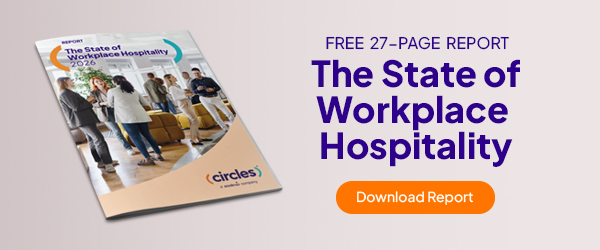
Our State of Workplace Hospitality Report 2026 explores how leading organizations are using hospitality principles to create workplaces that strengthen engagement, improve retention and deliver measurable business results. Drawing on the latest industry research, employee data and real-world client outcomes, the report examines why workplace hospitality has become a strategic capability rather than simply another workplace amenity.
Here are a few of the biggest insights from this report.
1. The office must earn the commute
Hybrid work permanently changed employee expectations. People now compare every trip into the office against the convenience, flexibility and the comfort of working from home.
That means organizations can no longer rely on attendance policies alone. The workplace itself has to provide meaningful value.
Gallup reports that just 20% of employees worldwide are engaged, while employee engagement has now declined for two consecutive years. At the same time, 51% of employees rank work-life balance among their highest priorities, making the overall workplace experience more influential than ever.
The most successful organizations are shifting their focus from managing space to creating destinations employees choose to visit.
2. Belonging — not amenities — is what brings people back
Many organizations continue investing in upgraded offices, new technology and workplace amenities. While these enhancements matter, they aren't the primary reason employees return.
In our own client research, 90% of employees said belonging and team connection are their biggest motivations for coming into the office.
That finding reinforces a broader trend appearing throughout today's workplace research: employees increasingly value meaningful relationships, community and shared experiences over physical perks alone.
Creating those moments doesn't happen by accident. It requires intentional hospitality, thoughtful programming and experiences designed to help people connect.

3. Employee experience has become a measurable business strategy
Workplace hospitality isn't simply about creating a welcoming environment — it delivers measurable business outcomes.
Research highlighted in the report shows:
- Employee turnover cost U.S. organizations more than $800 billion in 2025.
- Teams with strong belonging report 23% higher profitability and 81% lower absenteeism.
- Employees who feel valued are 65% less likely to be actively looking for another job.
As organizations continue balancing productivity, retention and workplace investment, employee experience is increasingly becoming a financial conversation, not just a cultural one.
4. One-size-fits-all workplaces no longer work
Today's workforce spans multiple generations, life stages and personal expectations.
Younger employees often prioritize flexibility, wellness and lifestyle integration, while other generations place greater value on convenience, consistency and reliable support. At the same time, expectations differ across countries and cultures, requiring global organizations to balance consistency with local relevance.
The report explores why personalization has become one of the defining characteristics of successful workplace hospitality, and why static benefits and amenities strategies are no longer enough.
5. Technology should strengthen human connection, not replace it
AI, workplace analytics and digital service platforms are rapidly transforming how organizations manage the employee experience.
Used well, technology helps organizations remove friction, personalize services and continuously improve workplace experiences through real-time insights.
But adoption also brings new responsibilities. Employees expect transparency around how workplace data is collected and used, making trust just as important as innovation.
The organizations seeing the strongest results are using technology to support hospitality — not automate away the human moments that employees value most.
6. Hospitality is becoming a competitive advantage
Perhaps the biggest takeaway from this year's report is that workplace hospitality has evolved from a "nice-to-have" into a strategic business capability.
Leading organizations are rethinking every interaction—from arrival and visitor experiences to concierge services, community programming and workplace support—to create environments where employees feel welcomed, supported and connected.
The result is stronger engagement, better retention, improved occupancy and workplaces that employees actively choose rather than simply attend.
These insights represent only a portion of what we uncovered. The full report explores the research in greater depth, including emerging workplace trends, generational and global insights, return-to-office strategies, AI and technology, sustainability, ROI measurement, implementation frameworks and real-world case studies showing how organizations are successfully putting workplace hospitality into practice.
Download the full report to discover how workplace hospitality can help your organization create a workplace employees genuinely want to experience.
Trends
